Property API Documentation - version 2.0.x
Welcome to PropertyAPI
Welcome to Outra's PropertyAPI, the gateway to the UK's most comprehensive property, household, and mover intelligence platform.
PropertyAPI enables you to enrich, segment, and activate audiences using a single, authoritative view of property truth. Built for marketers, data teams, and product engineers, Outra transforms fragmented housing data into actionable insight at scale.
Whether you are powering audience activation, analytics, or internal decision-making, Outra allows you to build with verified, reconciled, and explainable property data.
Why Choose PropertyAPI?
Property data is inherently noisy. Listings conflict, lifecycle events overlap, and statuses often disagree. Outra resolves this complexity through a logic engine that ingests multiple trusted sources and produces a single view of truth at the property level. Listings, prices, lifecycle events, and outcomes are reconciled into one consistent and reliable model, removing duplication and uncertainty.
Unlike generic property APIs, Outra is designed end-to-end for audience activation. It supports household and mover identification, lifecycle-driven segmentation, anniversary and predictive audiences, and activation-ready outputs built for modern advertising platforms. From raw data to insight to activation, everything is delivered through one unified platform.
PropertyAPI is built to be simple and predictable to integrate. It follows REST-based design principles, uses consistent response structures, provides clear pagination and metadata, and applies predictable error handling. Whether integrating into a CDP, DSP, or internal analytics stack, the API fits cleanly into existing workflows.
Accuracy matters when decisions are expensive. Outra delivers regularly refreshed datasets, modelled predictions such as mover likelihood and predicted completion dates, confidence-scored outputs, and fully auditable logic. You are not just consuming data; you are consuming explainable intelligence.
The platform scales seamlessly from pilot projects to always-on enterprise delivery. Access models are flexible, outputs can be provided at audience or property level, and delivery is designed to operate reliably at national scale.
Getting Started
Your journey with Outra begins here. The documentation provides clear authentication guidance, endpoint references, example requests and responses, and practical enrichment and audience patterns to help you get live quickly.
Need Help?
Our team works closely with partners throughout onboarding and beyond, supporting both technical integration and audience strategy. If you have questions or want to explore advanced use cases, we are here to help.
Root URL
All endpoints are accessible via the base URL https://outra-api.k8s.outra.co.uk/api/v2
API versioning is applied at the root level to ensure backward compatibility as the platform evolves.
Specifications
PropertyAPI is built for enterprise-grade interoperability and provides downloadable specifications to support rapid integration, testing, and internal documentation. These specifications can be imported directly into tools such as Postman, Swagger, or any OpenAPI-compatible client, enabling teams to explore endpoints, validate responses, and accelerate development workflows.
API Design Principles
The Outra API follows RESTful design standards, providing predictable resource-based endpoints, consistent request and response structures, standard HTTP methods, and clear status codes. This approach allows developers to integrate quickly and confidently across languages and frameworks while consuming data in a uniform, activation-ready format.
Testing & Development
Before deploying to production, we recommend testing API requests using a third-party client. At Outra, we use Postman for both web-based and desktop testing, enabling authentication via OAuth2, inspection of request and response payloads, validation of pagination and filtering behaviour, and verification of error handling. For more information, visit postman.com.
API ENDPOINTS
GET /property-lookup
GET /property-lookup-detailed
GET /property/address
GET /property/attributes
GET /property/valuation
GET /property/energy
GET /property/planning
GET /property/construction
GET /property/demographics
GET /signals/premover
GET /signals/homemover
GET /signals/upstix
GET /market-events/property-history
GET /market-events/rental-listings
Property Lookup
GET /property-lookup
Search for one or more properties using structured filters, free-text address matching, or a combination of both. Designed for fast discovery, address resolution, and bulk property exploration.
Overview
The Property Lookup endpoint enables two complementary search modes:
Filter-based search – Query the property dataset using structured conditions (e.g. postcode patterns).
Address-based search – Resolve a free-text address to the most likely matching properties, with confidence scoring.
Both modes can be combined to narrow results further.
1. Filter-Based Search
Use the filter query parameter to apply structured constraints.
Filter Object Structure
{"where":
  {"postcode":{
    "ilike":"EX2 8FR"
    }
  },
  "limit":10
}
2. Address-Based Search
Provide a free-text address string via the address parameter. 88 Chantry Meadow EX2 8FR Must include a postcode
Returns the top 10 best matches
Each match includes a confidence score
Can be combined with filter for post-matching refinement
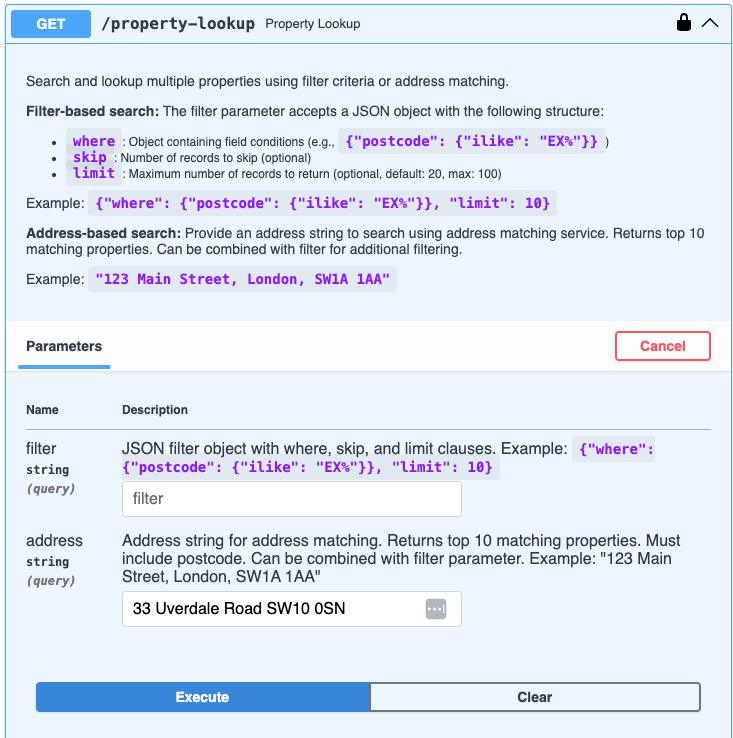
Request Sample - Filter based search
curl 'https://property-api.k8s.outra.co.uk/api/v2/property-lookup?filter={"where":{"postcode":{"like":"EX2 8FR"}},"limit":10}\
  -H 'accept: application/json' \
  -H 'authorization: {Bearer-Token}'
Request Sample - Address based search
curl 'https://property-api.k8s.outra.co.uk/api/v2/property-lookup?address=88 Chantry Meadow EX2 8FR\
  -H 'accept: application/json' \
  -H 'authorization: {Bearer-Token}'
Response Sample
  "success": true,
  "data": [
    {
      "building_name": null,
      "building_number": "88",
      "dependent_locality": null,
      "dependent_thoroughfare": null,
      "double_dependent_locality": null,
      "latitude": 50.6963103,
      "longitude": -3.5303529,
      "post_town": "Exeter",
      "postcode": "EX2 8FR",
      "sub_building_name": null,
      "thoroughfare": "Chantry Meadow",
      "udprn": 8763773,
      "uprn": 100040206758,
      "x_coordinate": 292013,
      "y_coordinate": 89637
    }
  ],
  "metadata": {
    "count": 1,
    "limit": 10,
    "has_filter": true,
    "address_search": true,
    "address_matches_found": 1,
    "address_confidence_scores": [
      {
        "uprn": "100040206758",
        "confidence": 1
      }
    ],
    "timestamp": "2026-01-07T20:25:37.618004Z"
  },
  "version": "2.0"
}
Detailed Property by UPRN
GET /property-lookup-detailed
Retrieve complete property details for a single UPRN, including all available field groups:
- ADDRESS
- ATTRIBUTES
- CONSTRUCTION
- DEMOGRAPHICS
- VALUATION
- ENERGY
- PLANNING
- MARKET
Use this endpoint when you already know the UPRN and need a full, enriched property record (rather than discovery/search).
UPRN Validation Rules
The uprn parameter must:
Be a positive integer fall within: 1 → 999999999999
Example GET /api/v2/property-lookup-detailed?uprn=100023336956
Typical Use Cases
Property profile pages (full attribute view by UPRN)
Enrichment pipelines (fetch complete dataset for a known property)
QA / verification of property truth records across sources
Pre-valuation workflows (valuation + EPC + planning + market context)
Request Sample
curl 'https://property-api.k8s.outra.co.uk/api/v2/property-lookup-detailed?uprn=100023336956' \
  -H 'accept: application/json' \
  -H 'authorization: {Bearer-Token}'
Successful response will be like
{
  "success": true,
  "data": {
   ...data fields...
  },
  "metadata": {
    "found": true,
    "uprn": 123452345,
    "field_groups": [
      "ADDRESS",
      "ATTRIBUTES",
      "CONSTRUCTION",
      "DEMOGRAPHICS",
      "VALUATION",
      "ENERGY",
      "PLANNING",
      "MARKET"
    ],
    "timestamp": "2026-01-07T20:07:48.913865Z"
  },
  "version": "2.0"
}
Property Address
GET /property/address
The Property Address endpoint retrieves the ADDRESS field group for a single property using its UPRN (Unique Property Reference Number). It returns only address and geospatial data, making it highly optimised for lightweight, high-frequency requests where fast location resolution is required.
This endpoint is ideal for applications that need precise address details, coordinates, or hierarchical building information without the overhead of broader property datasets.
Purpose
Accurate Address Resolution
This endpoint provides a canonical, UPRN-backed address structure, ensuring consistent and reliable address representation across systems and workflows.
High-Performance Location Lookups
By returning only address and coordinate fields, the endpoint is designed for low-latency use cases such as UI rendering, autocomplete confirmation, and rapid data hydration.
Geospatial Enablement
Built-in coordinate and latitude/longitude fields allow immediate integration with mapping, routing, and spatial analysis tools.
Returned Field Group
ADDRESS
Address and location attributes organised by hierarchy and geography.
Core location
- postcode
- latitude
- longitude
- x_coordinate
- y_coordinate
- uprn
These fields support mapping, distance calculations, and spatial indexing.
Building hierarchy
- sub_building_name
- building_name
- building_number
Street & locality
- dependent_thoroughfare
- thoroughfare
- double_dependent_locality
- dependent_locality
These fields provide full street and locality context, enabling precise address construction and display across regions.
Typical Use Cases
Map Rendering & Geocoding
Quickly position properties on maps using precise coordinates and UPRN-backed location data.
Address Normalisation
Standardise addresses across systems by resolving them to a single authoritative structure.
Autocomplete Resolution
Confirm and enrich user-selected addresses during search and onboarding flows without expensive data calls.
Fast UPRN → Address Hydration
Rapidly hydrate address details once a UPRN has been identified, supporting efficient downstream processing.
Pre-Enrichment UI Calls
Power responsive user interfaces that require instant address context before deeper property enrichment occurs.
Request Sample
curl /property/address  Chantry Meadow EX2 8FR\
  -H 'accept: application/json' \
  -H 'authorization: {Bearer-Token}'
Successful response will be like
  "success": true,
  "data": {},
  "metadata": {
    "found": true,
    "uprn": 0,
    "timestamp": "2026-01-29T10:57:44.158Z"
  },
  "version": "2.0"
}
Property Attributes
GET /property/attributes
The Property Attributes endpoint retrieves detailed structural, internal, and construction-related information for a single property using its UPRN (Unique Property Reference Number). It returns the ATTRIBUTES and CONSTRUCTION field groups, providing a comprehensive profile of a property’s physical characteristics and layout.
This endpoint is designed to support property profiling, valuation context, and data enrichment workflows, enabling downstream systems to make informed decisions based on a property’s form, size, and build quality.
Purpose
Comprehensive Property Profiling
This endpoint provides a structured view of a property’s internal configuration and construction features, allowing users to understand how a property is built, arranged, and used. This information is foundational for accurately representing a property across platforms and analytical models.
Improved Valuation & Contextual Analysis
By supplying key indicators such as floor area, room counts, heating type, glazing, and roof construction, the endpoint enhances valuation models, pricing tools, and risk assessments with reliable physical context.
Data Enrichment & Consistency
Using a UPRN as the primary identifier ensures consistent enrichment across systems, helping organisations maintain clean, standardised property records across multiple workflows and products.
Returned Field Groups
ATTRIBUTES
Core internal and usage characteristics describing how the property is laid out and occupied:
- property_type
- floor_area
- bedrooms
- bathrooms
- kitchens
- garage
- garage_spaces
- parking
- heating
- entrancefloor
- gardenarea
- instruction_type
- number_habitable_rooms
These fields are commonly used to assess liveability, suitability, and comparability between properties.
CONSTRUCTION
Physical build and material indicators that describe how the property is constructed:
- multi_glaze_proportion
- windows_description
- primary_roof_type
These attributes provide important signals for energy efficiency, maintenance considerations, and long-term durability.
Typical Use Cases
Property Profile Pages
Power detailed property pages with accurate, structured descriptions of internal layout and construction, enabling clearer communication with buyers, sellers, and tenants.
Automated Valuation Models (AVMs)
Enhance pricing accuracy by supplying key physical inputs such as size, room counts, glazing, and roof type to valuation and pricing algorithms.
Energy & EPC Pre-Analysis
Support early-stage energy efficiency assessments by providing construction and glazing indicators before formal EPC data is available.
Data Enrichment Pipelines
Enrich internal property databases using a UPRN-driven workflow to ensure consistency across CRM systems, analytics platforms, and reporting tools.
Buyer & Seller Insight Tools
Help users understand how a property compares to similar homes, highlighting structural features that influence desirability, comfort, and long-term costs.
Request Sample
curl /property/attributes  Chantry Meadow EX2 8FR\
  -H 'accept: application/json' \
  -H 'authorization: {Bearer-Token}'
Successful response will be like
  "success": true,
  "data": {},
  "metadata": {
    "found": true,
    "uprn": 0,
    "timestamp": "2026-01-29T10:57:15.535Z"
  },
  "version": "2.0"
}
Property Valuation
GET /property/valuation
The Property Valuation endpoint retrieves the VALUATION field group for a single property using its UPRN (Unique Property Reference Number). It provides capital value estimates, rental value indicators, reinstatement cost estimates, and associated confidence metrics.
This endpoint is optimised for pricing, insurance, lending, and financial analysis workflows, where both value and certainty are required to support informed decision-making.
Purpose
Reliable Property Value Context
This endpoint delivers structured valuation outputs that help users understand a property’s current market value and rental potential, providing a foundation for pricing decisions and financial modelling.
Insurance & Reinstatement Insight
Reinstatement cost estimates support buildings insurance calculations, enabling accurate assessment of rebuild costs under different methodologies and risk tolerances.
Confidence-Aware Decision Making
By returning confidence metrics alongside valuation figures, the endpoint allows consumers of the data to assess reliability, apply thresholds, or communicate uncertainty transparently.
Returned Field Group
VALUATION
Valuation, rental, and cost-related attributes, grouped by use case.
Market value
Indicators of a property’s capital and rental worth:
- property_value
- property_rental_value
These fields are commonly used in pricing tools, AVMs, and affordability assessments.
Reinstatement costs Estimated rebuild costs for insurance and risk modelling purposes:
- reinstatement_cost_notional
- reinstatement_cost_outra
- reinstatement_cost_final_adjusted_azur
- reinstatement_cost_higher_rate_azur
Multiple cost variants allow consumers to select estimates appropriate to their coverage requirements or regulatory frameworks.
Confidence metrics Confidence scores associated with valuation and cost outputs.
These metrics enable:
- Risk-aware pricing decisions
- Confidence-based filtering in automated workflows
- Transparent disclosure of estimate reliability to end users
Typical Use Cases
Automated Valuation Models (AVMs)
Provide valuation inputs or benchmarking data for pricing engines and property analytics platforms.
Insurance Reinstatement Pricing
Support accurate buildings insurance premiums and coverage calculations using reinstatement cost estimates.
Mortgage & Lending Workflows
Enhance underwriting and affordability checks with reliable valuation context and confidence scoring.
Portfolio Valuation & Analytics
Aggregate valuation data across property portfolios for reporting, exposure analysis, and performance tracking.
Pricing Confidence Disclosure
Surface confidence indicators alongside valuation figures to help users understand reliability and risk.
Request Sample
curl /property/valuation  Chantry Meadow EX2 8FR\
  -H 'accept: application/json' \
  -H 'authorization: {Bearer-Token}'
Successful response will be like
  "success": true,
  "data": {},
  "metadata": {
    "found": true,
    "uprn": 0,
    "timestamp": "2026-01-29T10:56:59.292Z"
  },
  "version": "2.0"
}
Property Energy
GET /property/energy
The Property Energy endpoint retrieves the ENERGY field group for a single property using its UPRN (Unique Property Reference Number). It provides energy efficiency ratings, consumption metrics, cost indicators, along with confidence scores and modelling flags that describe how the data has been derived.
This endpoint is optimised for EPC-style analysis, sustainability assessment, and energy-focused decision-making, supporting both regulatory and consumer-facing use cases.
Purpose
Energy Efficiency Visibility
This endpoint delivers a clear view of a property’s current and potential energy performance, enabling users to understand efficiency levels and improvement opportunities.
Compliance & Risk Assessment
Energy ratings and consumption metrics support regulatory checks, eligibility assessments, and risk analysis, particularly in contexts where energy performance directly impacts lending, insurance, or compliance decisions.
Modelling Transparency
Confidence scores and modelling flags provide transparency into data quality and estimation methods, allowing users to account for uncertainty in automated or advisory workflows.
Returned Field Group
ENERGY
Energy performance, consumption, and modelling attributes grouped by analytical purpose.
Efficiency & Rating
Indicators of overall energy performance:
- current_energy_efficiency
- current_energy_rating
These fields align with EPC-style scoring frameworks and are commonly used in compliance and consumer reporting.
Consumption Metrics
Estimates of current and potential energy usage:
- energy_consumption_current
- energy_consumption_potential
These metrics support benchmarking, scenario modelling, and retrofit analysis.
Cost Indicators
Representative energy-related cost signals:
- lighting_cost_current
Used to communicate running costs and efficiency impacts to end users.
Model Metadata
Confidence scores and modelling indicators associated with energy outputs.
These fields enable:
- Confidence-aware decision making
- Filtering or weighting in automated models
Transparent disclosure of estimate reliability
Typical Use Cases
EPC and Energy Compliance Checks
Validate energy ratings and efficiency metrics against regulatory or internal thresholds.
Sustainability & Retrofit Analysis
Identify properties with high improvement potential and assess the impact of energy-efficiency upgrades.
Green Mortgage Eligibility
Support eligibility checks for energy-linked lending products and incentives.
Portfolio Energy Benchmarking
Compare energy performance across property portfolios to identify risk, opportunity, and progress against sustainability targets.
Consumer-Facing Energy Insights
Surface clear, understandable energy information within property listings, dashboards, or advisory tools.
Request Sample
curl /property/energy  Chantry Meadow EX2 8FR\
  -H 'accept: application/json' \
  -H 'authorization: {Bearer-Token}'
Successful response will be like
  "success": true,
  "data": {},
  "metadata": {
    "found": true,
    "uprn": 0,
    "timestamp": "2026-01-29T10:56:44.319Z"
  },
  "version": "2.0"
}
Property Planning
GET /property/planning
The Property Planning endpoint retrieves the PLANNING field group for a single property using its UPRN (Unique Property Reference Number). It provides planning application history, approval signals, and recent development activity, giving visibility into how a property has changed — or may change — over time.
This endpoint is designed to support due diligence, development risk assessment, and market context analysis, particularly in transactions or investment scenarios where planning history is a critical factor.
Purpose
Planning History Transparency
This endpoint surfaces recent planning activity, allowing users to understand whether a property has been extended, redeveloped, or subject to planning scrutiny in recent years.
Risk & Opportunity Assessment
By exposing approval counts, application volume, and development types, the endpoint helps identify development risk, opportunity, or complexity before progressing with transactions or investment decisions.
New-Build Identification
Signals related to recent approvals enable accurate identification of new-build or recently consented homes, supporting downstream classification and pricing workflows.
Returned Field Group
PLANNING
Planning and development attributes structured to support analysis and screening.
Historic activity (last 5 years)
Summary indicators of recent planning engagement:
- planning_approvals_past_5_years
- planning_applications_past_5_years
These fields provide a quick signal of planning intensity and change frequency.
Most recent planning record Details of the latest planning activity associated with the property:
- most_recent_planning_app_date
- most_recent_planning_dev_type
- most_recent_planning_stage
- most_recent_planning_start_date
These attributes help determine recency, status, and nature of development activity.
New build indicator
- most_recent_new_home_approval
Used to flag properties that have recently received new-home planning approval, supporting classification and eligibility checks.
Typical Use Cases
Conveyancing & Due Diligence
Surface recent planning activity early in the transaction process to identify potential issues or additional checks.
Development & Extension Risk Analysis
Assess the likelihood of unauthorised works, incomplete developments, or future planning constraints.
New-Build Identification
Identify newly approved or recently developed homes for pricing, eligibility, or reporting workflows.
Investor Screening
Support acquisition decisions by highlighting properties with significant development history or planning complexity.
Market Context Enrichment
Add planning context to property profiles, valuations, and market analysis tools.
Request Sample
curl /property/planning  Chantry Meadow EX2 8FR\
  -H 'accept: application/json' \
  -H 'authorization: {Bearer-Token}'
Successful response will be like
  "success": true,
  "data": {},
  "metadata": {
    "found": true,
    "uprn": 0,
    "timestamp": "2026-01-29T10:56:28.309Z"
  },
  "version": "2.0"
}
Property Construction
GET /property/construction
The Property Construction endpoint retrieves the CONSTRUCTION field group for a single property using its UPRN (Unique Property Reference Number). It provides insight into a property’s building fabric, glazing, roof type, and internal structural characteristics, along with confidence scores and modelling flags that describe how the data has been derived.
This endpoint is designed to support energy modelling, valuation accuracy, insurance risk assessment, and professional property analysis, where construction details materially affect outcomes.
Purpose
Building Fabric Visibility
This endpoint surfaces key indicators of how a property is constructed and finished, enabling a deeper understanding of durability, performance, and maintenance considerations.
Energy & Risk Context
Construction attributes such as glazing proportion and roof type are critical inputs for EPC modelling, retrofit planning, and insurance risk profiling.
Confidence-Aware Modelling
Associated confidence scores and modelling flags allow users to assess reliability and apply appropriate weighting in automated or professional workflows.
Returned Field Group
CONSTRUCTION
Construction and physical fabric attributes grouped by analytical focus.
Structure & fabric Indicators describing the external and core fabric of the building:
- primary_roof_type
- windows_description
- multi_glaze_proportion
These fields influence energy performance, maintenance costs, and resilience assessments.
Internal layout
Structural indicators related to internal configuration:
- number_habitable_rooms
Used in valuation models, occupancy analysis, and surveyor tooling.
Model metadata
Confidence scores and construction modelling flags associated with the returned attributes.
These enable:
- Risk-aware decision making
- Model calibration and filtering
- Transparent disclosure of data certainty
Typical Use Cases
EPC Modelling & Retrofit Assessment
Provide construction inputs required to estimate energy performance and assess retrofit opportunities.
Insurance Risk Profiling
Support underwriting decisions by exposing construction characteristics that affect rebuild cost and risk exposure.
Valuation Input Enrichment
Improve valuation accuracy by incorporating physical fabric and layout indicators.
Surveyor & Lender Tooling
Equip professional tools with construction context to support inspections, lending decisions, and reporting.
Portfolio Fabric Analysis
Analyse construction characteristics across portfolios to identify systemic risk, retrofit potential, or exposure trends.
Request Sample
curl /property/construction  Chantry Meadow EX2 8FR\
  -H 'accept: application/json' \
  -H 'authorization: {Bearer-Token}'
Successful response will be like
  "success": true,
  "data": {},
  "metadata": {
    "found": true,
    "uprn": 0,
    "timestamp": "2026-01-29T10:59:19.267Z"
  },
  "version": "2.0"
}
Property Market
The Property Market endpoint retrieves the MARKET field group for a single property using its UPRN (Unique Property Reference Number). It consolidates recent sale, rental, and listing activity into a single response, providing a clear view of both a property’s current market status and its historical transaction context.
This endpoint is designed to support market visibility, pricing analysis, and transaction-aware decision making, across consumer-facing and professional property workflows.
Purpose
Market Activity Insight
This endpoint surfaces recent transaction and listing signals, enabling users to understand how recently a property has transacted, how often it comes to market, and whether it is currently available.
Pricing Context & Guidance
Offer price ranges and historic sale or rental values provide context for pricing decisions, negotiations, and valuation comparisons.
Live Listing Awareness
On-market indicators and listing URLs allow applications to distinguish between active, inactive, and historically traded properties in real time.
Returns Field Group
MARKET
Market activity and pricing attributes grouped by analytical intent.
Recent Transaction History
Signals describing historic sales and rental activity:
- Most recent sale price and sale date
- Days since the last sale
- Most recent rental price
- Days since the last rental
These fields provide insight into liquidity, holding periods, and transaction recency.
Current Market Status
Indicators of active market presence:
- Whether the property is currently on the market
- Active listing URL (where applicable)
- Listing end or finalisation date
Used to power live availability checks and listing integrations.
Pricing Guidance
Indicative offer price boundaries:
- Upper bound of offer price range
- Lower bound of offer price range
These fields support pricing strategy, negotiation context, and market comparison.
Typical Use Cases
Live Market Monitoring**
Identify properties that are actively listed and track changes in market status.
Pricing & Negotiation Support
Use historic transaction data and current offer ranges to inform pricing discussions and expectations.
Valuation Context Enrichment
Provide market signals alongside valuation outputs to improve interpretability and confidence.
Investor & Portfolio Analysis
Analyse transaction frequency, holding periods, and pricing trends across property portfolios.
Consumer-Facing Property Profiles
Enhance property listings and dashboards with clear, up-to-date market context.
Request Sample
curl /property/market  Chantry Meadow EX2 8FR\
  -H 'accept: application/json' \
  -H 'authorization: {Bearer-Token}'
Successful response will be like
  "success": true,
  "data": {
    "uprn": 100023336956,
    "last_sale_price": 0,
    "last_sale_date": "2026-01-29",
    "sale_anniversary": 0,
    "last_rent": 0,
    "rent_anniversary": 0,
    "IS_ON_MARKET": true,
    "listing_url": "string",
    "listing_final_date": "2026-01-29",
    "offer_price_upper": 0,
    "offer_price_lower": 0
  },
  "metadata": {
    "found": true,
    "uprn": 0,
    "timestamp": "2026-01-29T11:00:01.448Z"
  },
  "version": "2.0"
}
Property Demographics
GET /property/demographics
The Property Demographics endpoint retrieves the DEMOGRAPHICS field group for a single property using its UPRN (Unique Property Reference Number). It provides modelled household and occupant insights, including segmentation, affluence indicators, income bands, lifestage context, and occupancy characteristics.
This endpoint is designed to support audience insight, targeting, and analytics workflows, enabling a deeper understanding of the households associated with a property while remaining suitable for aggregated and model-driven use cases.
Purpose
Household Insight & Context
This endpoint delivers a structured view of the likely household profile associated with a property, helping users understand who lives there and how household characteristics may influence behaviour or needs.
Segmentation & Targeting Enablement
Demographic segmentation and affluence indicators support targeted outreach, personalisation, and audience building, particularly for marketing, media, and customer engagement use cases.
Modelling Transparency
Occupancy confidence scores provide visibility into model certainty, allowing users to apply thresholds or weighting in analytics and activation workflows.
Returned Field Group
DEMOGRAPHICS
Household and occupant-related attributes grouped by analytical purpose.
Segmentation
Household segmentation identifiers:
- quanta_code
- quanta_name
These fields classify households into behavioural and socio-demographic segments for comparison and targeting.
Affluence & Income
Indicators of household economic profile:
- affluence_level
- household_income
- wa_household_income
Used to assess spending power, eligibility, and affordability signals.
Household Profile
Contextual indicators describing household structure and life stage:
- age_band_of_head_of_household
- lifestage
- household_composition
These attributes support lifestage-aware messaging and insight generation.
Occupancy Modelling
Indicators describing the type and certainty of occupancy:
- occupant_type
- Occupant confidence scores
These fields help distinguish between owner-occupied, rented, or alternative occupancy patterns, with associated certainty.
Typical Use Cases
Audience Segmentation & Targeting
Build and activate audiences based on household profile, affluence, and lifestage characteristics.
Lookalike & Propensity Modelling
Use demographic attributes as inputs to predictive models that identify similar or high-propensity households.
Media Planning & Activation
Inform channel selection, creative strategy, and budget allocation using household-level insight.
Affluence & Lifestage Insight
Understand how household characteristics vary across properties, areas, or portfolios.
Household-Level Analytics
Support aggregated analysis and reporting across large property datasets while maintaining consistent segmentation logic.
Request Sample
curl /property/demographics  Chantry Meadow EX2 8FR\
  -H 'accept: application/json' \
  -H 'authorization: {Bearer-Token}'
Successful response will be like
  "success": true,
  "data": {},
  "metadata": {
    "found": true,
    "uprn": 0,
    "timestamp": "2026-01-29T10:55:45.406Z"
  },
  "version": "2.0"
}
Property Signals
GET /signals
The Property Signals endpoint retrieves all available predictive and categorical property signals for a single property using its UPRN (Unique Property Reference Number). It consolidates multiple data layers — including premover predictions, lead categorisation, and supporting propensity or pricing indicators — into a single response.
This endpoint is optimised for workflows where the UPRN is already known and the latest signal layer is required for analytics, CRM enrichment, or decision-making.
Purpose
Predictive Move & Lead Signals
This endpoint provides premover confidence scores and HomeMover predictions, helping identify properties likely to enter the market soon. It also delivers lead categorisation for prospecting and marketing workflows.
Workflow & CRM Enrichment
Consolidated signals allow single-call enrichment of CRM systems, dashboards, or outbound marketing tools, ensuring the latest intelligence is applied consistently.
Verification & QA
By returning structured metadata, including whether a property exists, this endpoint also supports quality assurance and verification of signal outputs.
Returned Object
Signals Object
A single object containing all signal attributes for the property:
Premover Confidence
premover_confidence_score — Likelihood of the property moving soon.
HomeMover Predictions
move_flag — Predicted likelihood of a move. move_date — Estimated date of the predicted move. move_type — Type of move (e.g., downsizing, upsizing). event_type / event_date — Associated predicted events, with confidence metrics.
Lead Categorisation
upstix_lead_category — Classification for prospecting or segmentation purposes.
Supporting Propensity / Pricing Fields
Examples include stamp_duty_payable vs not_payable and other derived indicators relevant to pricing or transaction likelihood.
Metadata
- metadata.found — Boolean indicating whether the property exists in the system.
- data — Contains the signal object if found=true, or an empty object if found=false.
Typical Use Cases
Lead Scoring & Segmentation
Combine Premover confidence and Upstix lead category to prioritise outreach or marketing activity.
Trigger-Based Workflows
Automatically trigger actions (e.g., alerts or campaigns) using predicted move flags and estimated move dates.
CRM / Outbound Enrichment
Fetch all property signals in a single call to update contact records or dashboards with the latest intelligence.
QA / Verification
Verify signal outputs for individual UPRNs to ensure accuracy and consistency across datasets or models.
Request Sample
curl /signals Chantry Meadow EX2 8FR\
  -H 'accept: application/json' \
  -H 'authorization: {Bearer-Token}'
Successful response will be like
  "success": true,
  "data": {
    "uprn": "100023336956",
    "premover_confidence": 0,
    "predicted_move_flag": "string",
    "predicted_move_flag$confidence": 0,
    "predicted_move_date": "2026-01-29",
    "predicted_move_date$confidence": 0,
    "predicted_move_type_of_move": "string",
    "predicted_move_event_type": "string",
    "predicted_move_event_date": "2026-01-29",
    "offer_price_stamp_duty_payable": 0,
    "offer_price_stamp_duty_not_payable": 0,
    "propensisty_to_sell_under_market_value": 0,
    "upstix_lead_category": "string"
  },
  "metadata": {
    "found": true,
    "uprn": "100023336956"
  },
  "version": "2.0"
}
Premover Signals
GET /signals/premover
The Premover Signals endpoint retrieves the Premover confidence signal for a single property using its UPRN (Unique Property Reference Number). It provides a lightweight, focused response for workflows where only Premover intelligence is required, such as lead scoring, segmentation, or trigger-based activity.
This endpoint is optimised for fast lookups and large-scale scoring, making it ideal when low payload and high performance are priorities.
Purpose
Move Likelihood Insight
This endpoint delivers a single Premover confidence score, representing the likelihood that a household is preparing to move. It provides a quick, actionable signal for audience targeting and prioritisation.
Lightweight Alternative
Designed as a high-performance alternative to the full /signals endpoint, it is ideal when only Premover intelligence is needed, avoiding unnecessary data transfer and processing.
Returned Object
- premover_confidence_score — Indicates the probability that the household is planning to move.
- metadata — Minimal metadata to confirm property existence and enable fast lookup.
Typical Use Cases
Premover Audience Creation
Identify and build audiences of households likely to move in the near future.
Lead Prioritisation
Rank prospects based on move likelihood to optimise sales or outreach efforts.
CRM Enrichment
Quickly populate CRM records with Premover intelligence without retrieving full signal datasets.
Trigger-Based Marketing Workflows
Initiate campaigns or notifications based on predicted move signals.
Lightweight Signal Checks
Perform rapid pre-enrichment assessments before deeper property signal queries or modelling.
Request Sample
curl /signals/premover  Chantry Meadow EX2 8FR\
  -H 'accept: application/json' \
  -H 'authorization: {Bearer-Token}'
**Successful response will be like**
```{
"success": true,
"data": {
  "uprn": "100023336956",
  "premover_confidence": 0
},
"metadata": {
  "found": true,
  "uprn": "100023336956",
  "signal_type": "premover"
},
"version": "2.0"
}
Homemover Signal
GET /signals/homemover
The HomeMover Signals endpoint retrieves predictive move intelligence for a single property using its UPRN (Unique Property Reference Number). It provides detailed indicators of likely home movement, including move probability, estimated timing, move type, and associated confidence metrics, along with supporting propensity and transactional indicators.
This endpoint is designed to support move intent modelling, CRM enrichment, marketing prioritisation, and property lifecycle analysis.
Purpose
Predict Move Likelihood
The endpoint delivers predictions about the likelihood that a property will enter the market, helping organisations anticipate sales, plan outreach, and allocate resources effectively.
Move Timing & Type
Provides estimated move dates, predicted move types (e.g., upsizing, downsizing), and associated event types, enabling targeted campaigns and workflow automation.
Transactional & Propensity Signals
Includes supplementary indicators such as stamp duty applicability and propensity to sell under market value, which enhance decision-making in pricing, lead scoring, and portfolio analysis.
Returned Object
Key predictive fields include
- move_flag — Predicted likelihood that the property will move.
- move_date — Estimated move date.
- move_confidence_score — Confidence associated with the predicted move.
- move_type — Type of predicted move (e.g., downsizing, upsizing).
- event_type / event_date — Specific predicted move events, with timing.
- stamp_duty_indicator — Indicates whether stamp duty is expected.
- propensity_to_sell_under_market_value — Likelihood of sale below market price.
Metadata
- metadata.found — Boolean indicating whether the property exists.
- data — Signal object if found=true, empty object if found=false.
Typical Use Cases
Identifying Likely Home Movers
Detect properties with high predicted move probability for prospecting and engagement.
Predicting Sales Pipeline Volume
Estimate upcoming market activity to support resource planning and pipeline forecasting.
Prioritising Properties by Move Probability
Rank leads or properties based on predicted likelihood of moving for efficient outreach.
Enriching Lead Records with Move Intelligence
Enhance CRM or marketing databases with move timing, type, and propensity metrics.
Triggering Outbound Campaigns
Automatically initiate marketing or contact campaigns based on predicted move timing and confidence levels.
Request Sample
curl /signals/homemover  Chantry Meadow EX2 8FR\
  -H 'accept: application/json' \
  -H 'authorization: {Bearer-Token}'
**Successful response will be like**
```{
"success": true,
"data": {
  "uprn": "100023336956",
  "predicted_move_flag": "string",
  "predicted_move_flag$confidence": 0,
  "predicted_move_date": "2026-01-29",
  "predicted_move_date$confidence": 0,
  "predicted_move_type_of_move": "string",
  "predicted_move_event_type": "string",
  "predicted_move_event_date": "2026-01-29",
  "offer_price_stamp_duty_payable": 0,
  "offer_price_stamp_duty_not_payable": 0,
  "propensisty_to_sell_under_market_value": 0
},
"metadata": {
  "found": true,
  "uprn": "100023336956",
  "signal_type": "homemover"
},
"version": "2.0"
}
x
Upstix Signal
GET /signals/upstix
The Upstix Signal endpoint retrieves the Upstix lead category for a single property using its UPRN (Unique Property Reference Number). It provides a lightweight classification that segments properties based on commercial or marketing relevance, enabling quick decisions without fetching the full set of predictive signals.
This endpoint is optimised for fast lookups, CRM enrichment, and audience segmentation workflows.
Purpose
Lead Categorisation
Provides a single lead category per property, allowing users to segment, prioritise, or route properties in marketing and sales workflows.
Lightweight & High-Performance
Designed for minimal payload and high-speed responses, making it ideal when only lead classification is required, without the overhead of full signal datasets.
CRM & Audience Enrichment
Supports updating databases, dashboards, and targeting logic with a single actionable property-level classification.
Returned Object
- upstix_lead_category — A single classification value indicating the property’s commercial or marketing segment.
- metadata — Minimal metadata indicating property existence and retrieval status.
Example:
- metadata.found — Boolean indicating whether the property exists.
- data — Signal object if found=true, empty object if found=false.
Typical Use Cases
Lead Routing & Prioritisation
Assign properties to sales or marketing teams based on Upstix lead category.
Sales Segmentation
Group properties for focused engagement, campaigns, or analysis.
Marketing Audience Classification
Use classification to segment audiences for targeted messaging or campaigns.
Enrichment of Existing Property Datasets
Add Upstix categories to property records for analytics, reporting, or scoring.
Lightweight Pre-Scoring
Quickly identify high-priority properties before deeper signal fetches or full predictive modelling.
Request Sample
curl /signals/upstix  Chantry Meadow EX2 8FR\
  -H 'accept: application/json' \
  -H 'authorization: {Bearer-Token}'
Successful response will be like
  "success": true,
  "data": {
    "uprn": "100023336956",
    "upstix_lead_category": "string"
  },
  "metadata": {
    "found": true,
    "uprn": "100023336956",
    "signal_type": "upstix"
  },
  "version": "2.0"
}
Property Market Events History
GET /market-events/property-history
GET /market-events/property-history
The Property Market Events History endpoint retrieves the full market-facing event history for a single property using its UPRN (Unique Property Reference Number). It provides a chronological record of listings, delistings, price changes, and agent activity.
This endpoint is designed to support timeline visualisations, valuation analysis, agent monitoring, and property lifecycle auditing.
Purpose
Complete Market Activity Insight
Surfaces the historical market footprint of a property, allowing users to understand how the property has moved, been priced, and listed over time.
Transaction & Listing Transparency
Includes details on listing events, delistings, price changes, and transaction types, enabling accurate valuation, sales analysis, and market intelligence.
Agent & Branch Attribution
Provides information about the agents and branches involved in each market event, supporting performance tracking and operational insights.
Returned Object
Market events are returned as an array of structured objects, with each object representing a single market event.
Key fields include
- event_date — Date of the market event (most recent first).
- event_type — Type of event (e.g., listing, delisting, price change).
- price — Price associated with the event (if applicable).
- transaction_type — Nature of transaction (sale, rental, etc.).
- agent_name / branch_name — Agent or branch responsible for the event.
Notes
- Events are ordered by event_date descending, with the most recent events first.
- Limited to the latest 100 events per property to maintain performance and relevance.
Typical Use Cases
Property Timeline / History Views
Visualise the full sequence of market activity for a property in dashboards or reports.
Valuation & Pricing Analysis
Understand historical price movements and listing behaviour to support valuation models and pricing decisions.
Sales Performance Tracking
Monitor which properties are performing well or slowly in the market over time.
Agent Activity Monitoring
Track agent and branch involvement to assess performance, coverage, or market impact.
Event-Driven Analytics
Use market event sequences to trigger insights, alerts, or notifications based on changes in property status.
Property Lifecycle Auditing
Maintain a complete record of market-facing events for auditing, compliance, or due diligence purposes.
Request Sample
curl /market-events/property-history  Chantry Meadow EX2 8FR\
  -H 'accept: application/json' \
  -H 'authorization: {Bearer-Token}'
Successful response will be like
  "success": true,
  "data": [
    {
      "outra_id": "evt_12345",
      "uprn": 100023336956,
      "event_date": "2024-01-15",
      "event_type": "listed",
      "transaction_type": "sale",
      "agent_branch": "Estate Agent Ltd - Central Branch",
      "price": 450000
    }
  ],
  "metadata": {
    "uprn": 100023336956,
    "count": 12,
    "limit": 100,
    "timestamp": "2026-01-29T10:52:48.948Z"
  },
  "version": "2.0"
}
Sales Listings by Location
GET /market-events/sales-listings
The Sales Listings by Location endpoint retrieves active sales listings for a specified location. It returns properties listed in the last 90 days, optionally filtered by property type, style, bedroom count, and price, making it ideal for market analysis, property search, and discovery workflows.
This endpoint is optimised for location-based querying and recent market activity monitoring.
Purpose
Active Listings Insight
Provides a snapshot of currently available properties in a given area, allowing users to understand local supply, pricing trends, and market movement.
Location-Based Market Analysis
Supports postcode- and post town-level filtering, enabling detailed regional dashboards, competitor monitoring, and pricing comparisons.
Optional Property Filtering
Enables more targeted searches by property type, style, bedrooms, and price, useful for consumer-facing search, lead generation, and analytical workflows.
Search Behaviour
Location Matching
- Matches against POSTCODE and POST_TOWN fields.
- Case-insensitive.
- Partial matching supported:
- "SW1" → matches SW1A, SW1P, etc.
- "London" → matches all London post towns.
Date Rules
- Only includes listings with EVENT_DATE in the last 90 days.
Result Limits
- Maximum 100 listings per request.
- Ordered by EVENT_DATE descending (most recent first).
Parameters
| Name | Type | Required | Description |
|---|---|---|---|
| location | string | ✅ | Postcode or post town (e.g. SW1A, London) |
| property_style | string | ❌ | Filter by style (e.g. Detached) |
| property_type | string | ❌ | Filter by type (e.g. flat) |
| bedrooms_min | integer | ❌ | Minimum Bedrooms |
| bedrooms_max | integer | ❌ | Maximum Bedrooms |
| listing_price_min | number | ❌ | Min asking price |
| listing_price_max | number | ❌ | Max asking price |
Returned Object
Each listing object includes key sales listing information:
- uprn — Unique Property Reference Number.
- event_date — Listing creation date.
- price — Asking price.
- property_type — Type of property (e.g., Flat, Detached).
- property_style — Style of property (e.g., Semi-Detached).
- bedrooms — Number of bedrooms.
- postcode — Property postcode.
- post_town — Property post town.
- agent_name / branch_name — Listing agent and branch.
Typical Use Cases
Property Search & Discovery
Enable consumers or applications to browse active listings in a specified location.
Market Activity Dashboards
Track local market activity and trends for research or reporting purposes.
Area-Based Pricing Analysis
Analyse pricing trends by postcode or post town for valuations, insights, or competitive monitoring.
Lead Generation by Geography
Identify prospective properties or sellers in targeted areas.
Sales Pipeline Visibility
Support estate agents or investors in monitoring newly listed properties.
Listing Performance Analysis
Track how new listings enter the market, agent activity, and event frequency for performance reporting.
Request Sample
curl /market-events/sales-listings Chantry Meadow EX2 8FR\
  -H 'accept: application/json' \
  -H 'authorization: {Bearer-Token}'
Successful response will be like
  "success": true,
  "data": [
    {
      "UPRN": 100023336956,
      "LISTING_ID": "LST_12345",
      "TRANSACTION_TYPE": "sale",
      "EVENT_TYPE": "listed",
      "EVENT_DATE": "2024-12-01",
      "ADDRESS_LINE_1": "123 High Street",
      "ADDRESS_LINE_2": "Westminster",
      "POST_TOWN": "London",
      "POSTCODE": "SW1A 1AA",
      "POSTCODE_DISTRICT": "SW1A",
      "POSTCODE_SECTOR": "SW1A 1",
      "PROPERTY_STYLE": "Detached",
      "PROPERTY_TYPE": "House",
      "BEDROOMS": 4,
      "LISTING_PRICE": 750000
    }
  ],
  "metadata": {
    "location": "SW1A",
    "count": 45,
    "limit": 100,
    "date_range": {
      "from": "2026-01-29",
      "to": "2026-01-29"
    },
    "timestamp": "2026-01-29T10:52:26.174Z"
  },
  "version": "2.0"
}
Rental Listings History
GET /market-events/rental-listings
The Rental Listings History endpoint retrieves active rental property listings for a specified location. It returns listings from the last 90 days, filtered by location and optional property attributes such as type, style, bedrooms, and rent price.
This endpoint is designed for rental market monitoring, tenant demand analysis, and portfolio insight.
Purpose
Active Rental Listings Insight
Provides a snapshot of currently available rental properties, supporting analysis of local supply, rent levels, and market trends.
Location-Based Filtering
Supports filtering by postcode or post town, enabling detailed area-level analysis and reporting.
Optional Property Attribute Filters
Refine queries by property type, style, bedrooms, and rent price, enabling search, discovery, and analytical workflows.
Search Behaviour
Location Matching
- Matches against POSTCODE and POST_TOWN fields.
- Case-insensitive.
- Partial matching supported:
- "SW1" → matches SW1A, SW1P, etc.
- "London" → matches all London post towns.
Date Rules
Only includes listings with EVENT_DATE in the last 90 days.
Only listings where TRANSACTION_TYPE = 'RENT'.
Result Limits
Maximum 100 listings per request.
Ordered by EVENT_DATE descending (most recent first).
Parameters
| Name | Type | Required | Description |
|---|---|---|---|
| location | string | ✅ | Postcode or post town (e.g. SW1A, London) |
| property_style | string | ❌ | Filter by style (e.g. Detached) |
| property_type | string | ❌ | Filter by type (e.g. flat) |
| bedrooms_min | integer | ❌ | Minimum Bedrooms |
| bedrooms_max | integer | ❌ | Maximum Bedrooms |
| listing_price_min | number | ❌ | Min monthly rent |
| listing_price_max | number | ❌ | Max monthly rent |
Returned Object
Each listing object includes key rental information:
- uprn — Unique Property Reference Number.
- event_date — Listing creation date.
- rent — Monthly rental price.
- property_type — Type of property (e.g., Flat, Detached).
- property_style — Style of property (e.g., Semi-Detached).
- bedrooms — Number of bedrooms.
- postcode — Property postcode.
- post_town — Property post town.
- agent_name / branch_name — Listing agent and branch.
Typical Use Cases
Rental Market Analysis
Understand local rental supply and trends for investment, advisory, or reporting purposes.
Tenant Demand Tracking
Identify areas with high rental activity and emerging demand patterns.
Area-Based Rental Search
Enable consumer-facing applications to browse active rentals in a specific location.
Portfolio Monitoring
Track performance and availability of properties across multi-property portfolios.
Pricing Comparison Tools
Compare rental pricing across areas, property types, or styles.
Lettings Performance Dashboards
Monitor agent or branch activity and listing performance for operational insights.
Request Sample
curl /market-events/rental-listings  Chantry Meadow EX2 8FR\
  -H 'accept: application/json' \
  -H 'authorization: {Bearer-Token}'
Successful response will be like
  "success": true,
  "data": [
    {
      "UPRN": 100023336956,
      "LISTING_ID": "LST_67890",
      "TRANSACTION_TYPE": "rent",
      "EVENT_TYPE": "listed",
      "EVENT_DATE": "2024-12-01",
      "ADDRESS_LINE_1": "456 Park Lane",
      "ADDRESS_LINE_2": "Mayfair",
      "POST_TOWN": "London",
      "POSTCODE": "SW1A 2AA",
      "POSTCODE_DISTRICT": "SW1A",
      "POSTCODE_SECTOR": "SW1A 2",
      "PROPERTY_STYLE": "Apartment",
      "PROPERTY_TYPE": "Flat",
      "BEDROOMS": 2,
      "LISTING_PRICE": 2500
    }
  ],
  "metadata": {
    "location": "SW1A",
    "count": 32,
    "limit": 100,
    "date_range": {
      "from": "2026-01-29",
      "to": "2026-01-29"
    },
    "timestamp": "2026-01-29T10:51:37.076Z"
  },
  "version": "2.0"
}
Error Handling & Reference
HTTP Status Codes
| Code | Meaning |
|---|---|
| 200 | Success |
| 400 | Bad Request |
| 401 | Unauthorized |
| 403 | Forbidden |
| 404 | Not Found |
| 429 | Rate Limited |
| 500 | Server Error |
Error Response Example
{
  "error": {
    "code": "INVALID_PARAMETER",
    "message": "Invalid postcode format",
    "field": "postcode",
    "request_id": "req_123"
  }
}